


by Justin J. Long CFP® on Dec 2, 2025, 7:56:25 AM
Where We Were
2024 followed through on gains in 2023, driven higher by gradual declines in inflation expectations and gradual increases in employment, consumer spending, corporate earnings, and economic growth. Like 2023, 2024 began with Value, SMID and Foreign markets taking the lead, but overcome once again by US Large Cap Growth. Revenue and earnings growth in the Growth sectors drove performance again, while investors tried to absorb the fundamental realities of lower asset/higher margin within the Information Technology and Communication Services sectors, lamenting higher P/E ratios all year – while equities climbed even higher. Global equity benchmarks rose between 4% and 25% for the year, with the S&P 500 index taking the pole position once more. Developed Foreign equities gained 4%, Emerging markets 7%. Fixed income benchmarks struggled to stay above water last year, except higher risk, higher yielding benchmarks here at home, and foreign government bonds abroad – which were less constrained by inflation concerns. The US Aggregate Bond index gained just 1% last year, equal to investment grade corporate, mortgage-backed, and national muni bonds. High yield bonds carried the year with a gain of 8%, followed by the international aggregate index, up 5%.
Where We Are
Source: Factset
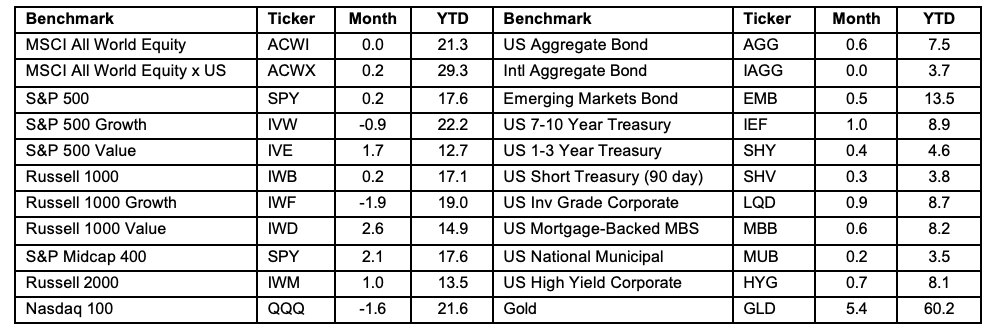
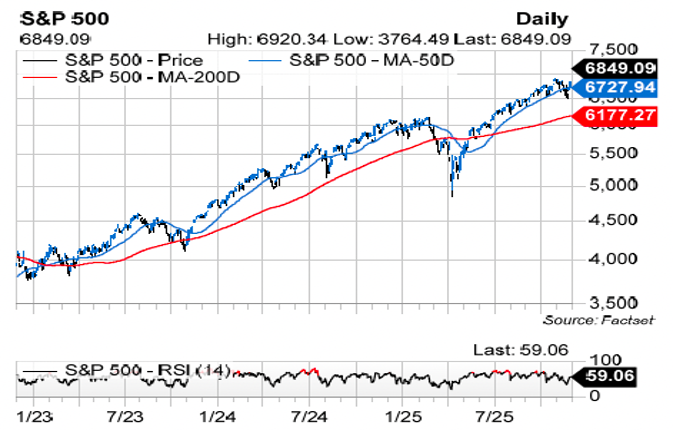
Still in Record High Territory. The S&P 500 index closed the month of November at 6849, having bounced back following a ~5% consolidation and within a sniff (1%) of the previous record of 6890. The index is up 17.6% YTD. [US Large Cap] Growth is up 22%, while Value is up 13%. The S&P 500 index is up 42% from the intraday low on April 7. The Nasdaq 100 has rebounded 54% from the same day's intraday low, and is also near (2%) the all-time high.
The US Aggregate Bond index is up 7.5% YTD (60/40 is up 13.6%). The 10-year T-Note yield is at 4.01%.
Q3 Results. With 97% of S&P 500 constituents reporting, 77% beat revenue estimates, with 9% y/y growth vs. the 5% forecast at the beginning of Q3. 83% of companies have beaten EPS estimates, with average growth of 13% vs. the 7% expected.
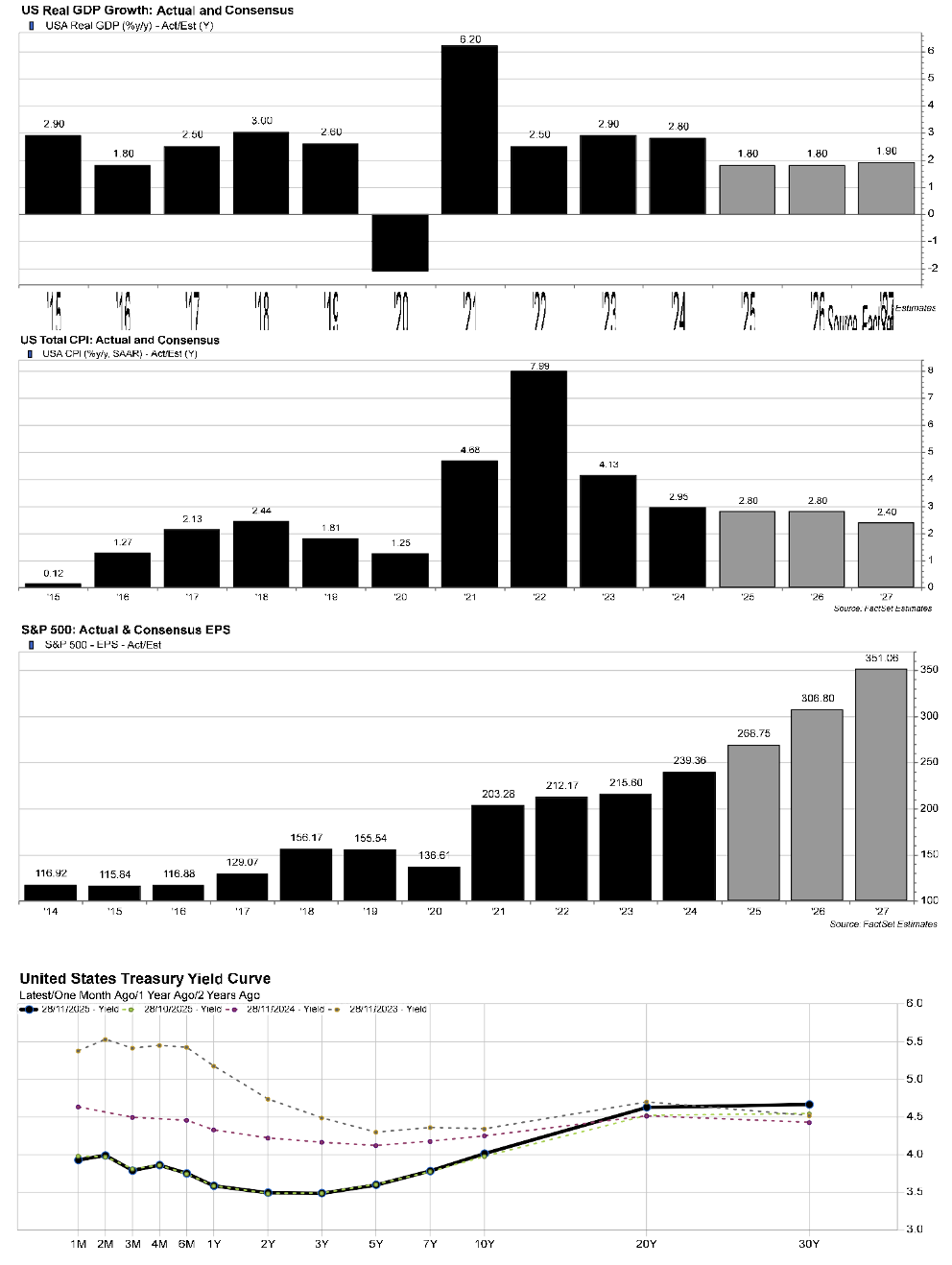
S&P 500 earnings expectations. For 2024, actual EPS was $240/share, up 12% vs. 2023. The 2025 estimate is $269 (+12%), up $2 vs. a month ago. The 2026 estimate is $307, up $3 over the last month (+14%), with 2027 up $6 to $351 (up $6). Each annual estimate is higher than it was six and twelve months ago.
P/E ratios for those estimates are 25x, 22x, and 20x. The P/E-to-Growth (PEG) ratios are 2.1, 1.6 and 1.4. The average EPS growth rate over the past 20 years is 7%; the average trailing and forward P/E ratios are 19x and 16x, while the 20-year average trailing PEG ratio is 2.7x. The consensus price target for the SPX is 7966, vs. 7741 a month ago and 7376 sixty days ago, for an implied total return of +16% from its current level. If achieved during this calendar year, the implied total return for the S&P 500 index in 2025 would be +33%.
Where We're Headed
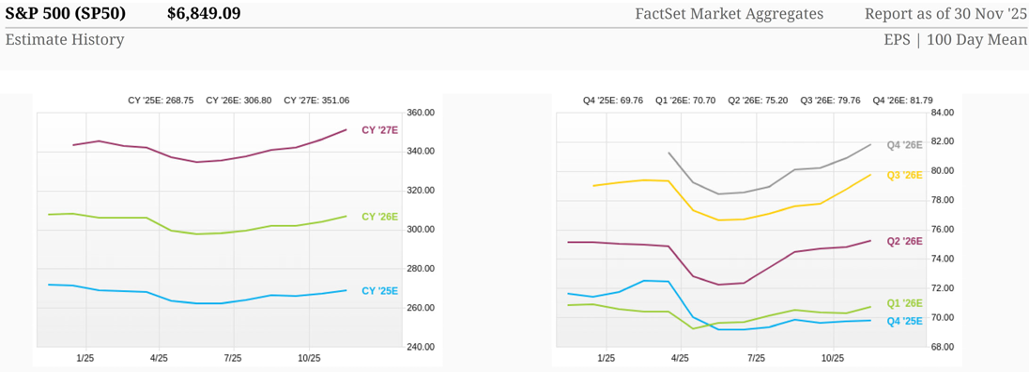
Markets are forward-discounting mechanisms; conditions expected in 2026 look “good enough”. It is clear that consumer spending and broad economic growth indicators are softer than they were at the beginning of the year, when the incoming Administration was riding a wave of lower-taxation/lower-regulation goodwill.
Tariff policy changes muddied the waters – both in terms of inflation expectations and confidence – changing the goodwill dynamic markedly. Estimates took a hit during the summer months, and for 2025 at least the estimates never topped those from January.
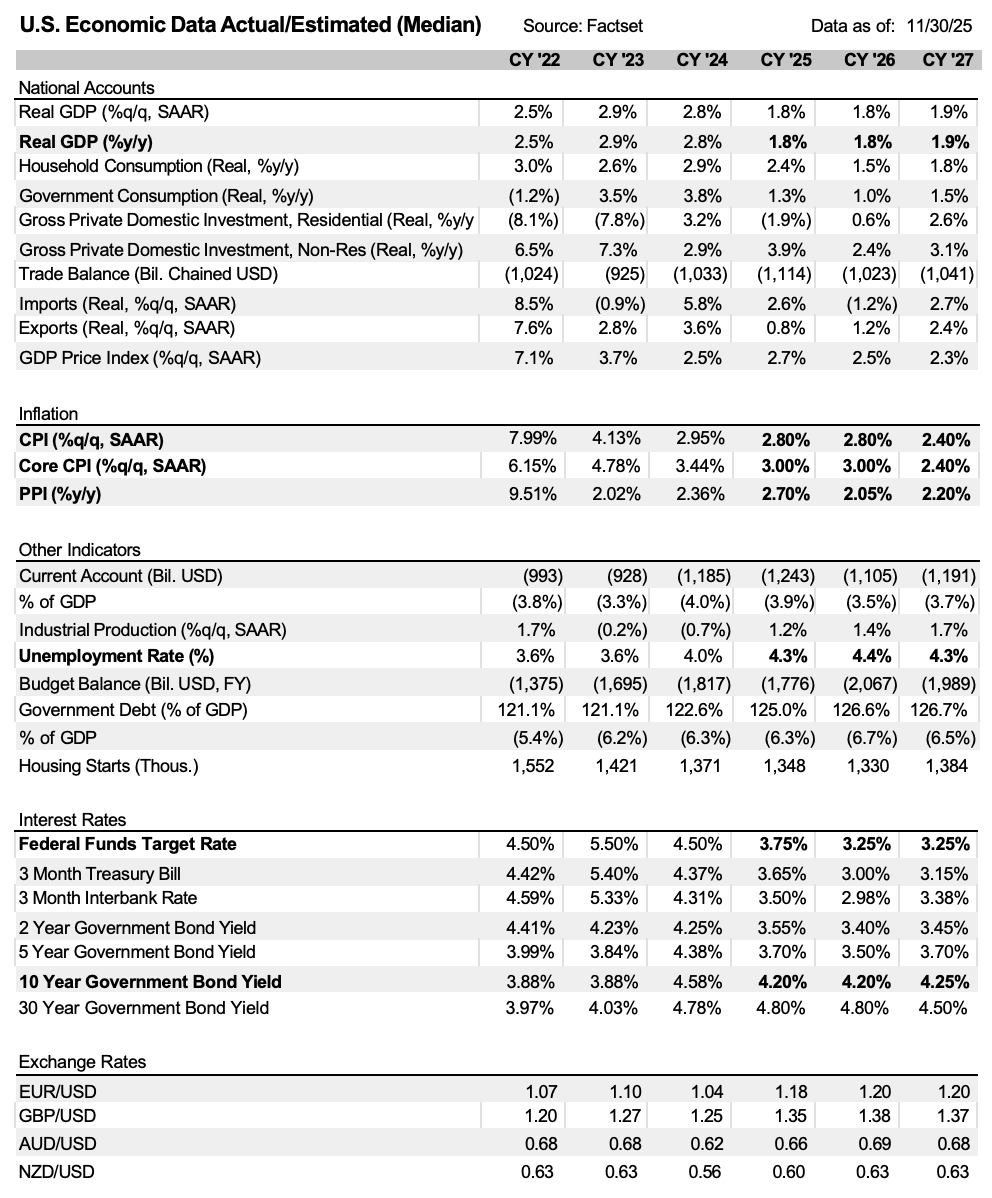
Since then, estimates have largely rebounded, but confidence has remained tepid. With inflation around 3% and nominal GDP growth a bit less than 5%, real GDP expansion looks to be in the 1.8% range over the next several years. The unemployment rate has ticked up slightly, but remains in the low 4% range. The Fed Funds rate is 3.75%-4.0%, off from the 2024 peak of 5.5%, perhaps on its way to 3.25% by the end of 2026. Meanwhile, against this backdrop, EPS growth for the S&P 500 index reflects 12% growth in 2025, followed by 14% in both 2026 and 2027. Much of that has to do with exceptional growth in the index-leading companies (Info Tech, Communication Services, Consumer Cyclicals, Industrials), which are expected to produce earnings growth at 2-4x the broader, equal weighted index (22% for Info Tech vs. 7% equal weight).
As noted above, the P/E-to-growth (PEG) ratios for the S&P 500 at the moment stand at 2.1x, 1.6x and 1.4x against a 20-year average of 2.7x. In other words, despite higher-than-average trailing and forward P/E multiples (25x and 22x), given 14% expected EPS growth for the next two years, the price paid per percentage point of growth is between 20-40% LOWER than the average paid over the past 20 years. And remembering that stock market benchmarks are market-cap weighted, it is actually reasonable that market multiples would be higher when index-leading companies are grossly outgrowing lower-weighted, more defensive or mature companies.
That’s not to say there won’t be corrections/consolidations following large and fast upside runs. The S&P 500 index has more than doubled over the past 3 years and at more than a 20% compounded annual growth rate, it has appreciated at over 2x the long-term average. In recent years we’ve seen rallies of 70% in just 18 months or so, followed by a 20% consolidation of that run (meaning up 50% in 18 months). Many folks take the negative side of that coin, while we take the perspective that extraordinary runs afford extraordinary selloffs, and that is neither an unusual nor negative condition for liquid markets. In fact, quite the contrary.
So with conditions looking favorable for “good enough” economic conditions and a dovish Fed against strong earnings growth, we could again see a decent (and non-recessionary) environment for stocks and bonds in 2026.
As always, please see the monthly Econ/Market slide deck for more details and perspectives.

Sources: Morningstar, Factset. Performance data represents past performance and is no guarantee of future results. This material has been compiled from sources deemed reliable; it is not guaranteed as to its accuracy and does not purport to be complete. All information contained herein is subject to change without notice. The information is not intended to be used as the basis of investment decisions.
